

How HDD Keeps Colorado’s Fiber Projects Moving Forward
Underground construction in Denver and the broader Front Range presents a mix of clay soils, river rock, congestion, and strict permitting requirements. For telecom providers expanding fiber infrastructure, Horizontal Directional Drilling (HDD) has become the preferred method to navigate these challenges with precision and minimal surface disruption.
Below is an overview of how HDD works, why it matters for telecommunications construction in Colorado, and what project owners should know when planning fiber builds in Denver’s evolving utility landscape.
What Is HDD and Why It Matters in Telecom Construction
HDD is a trenchless construction method used to install conduits, fiber, and other utilities beneath roads, sidewalks, landscaped areas, and environmentally sensitive locations. For telecom projects, HDD helps contractors place new fiber routes without the extended lane closures or open-cut excavations that cities like Denver increasingly restrict.
In growing metros along the Front Range — Denver, Aurora, Lakewood, Arvada, and Colorado Springs — HDD offers a cleaner, safer, and faster alternative that keeps communities moving while allowing providers to expand broadband networks.
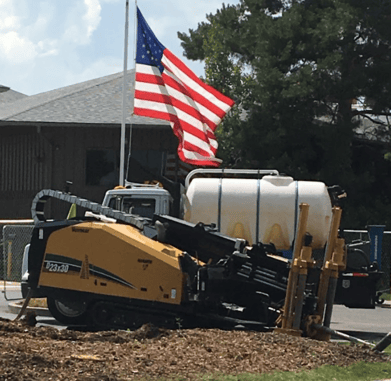
The Three Core Stages of a Typical HDD Operation in Colorado
Site Preparation
An HDD crew begins onsite by potholing existing utilities to determine their exact location and depth. In Denver’s dense utility corridors, accurate locates and potholing are critical to avoid telecom, water, gas, and Xcel Energy electric conflicts. Some projects on private land may not require potholing, but in the public right-of-way, this part of the project is critical.
Boring and Hole Conditioning
Once boring begins, locators track the drill head’s depth and alignment to ensure the route clears existing infrastructure.
Once the pilot bore is complete, the crew may enlarge the hole using reamers matched to the required conduit size. In Colorado soils — which often shift between soft clay and cobble — drilling fluid management becomes essential for stability and clean returns.
Proper fluid mix helps maintain bore integrity, controls cuttings, and reduces the risk of inadvertent returns during downtown or residential drilling.
Pullback and Conduit Installation
After the bore path is ready, the crew pulls the conduit bundle back through the hole. For telecom construction, this typically includes 1.25″ HDPE ducts, fiber microduct, or multi-duct packages designed for high-capacity networks.
A smooth pullback reduces stress on the conduit and sets the stage for efficient fiber cable installation and splicing.
Why HDD Works So Well in Colorado’s Urban and Mountain Environments
Minimal Surface Disruption
Denver Department of Transportation & Infrastructure and nearby municipalities often restrict open-cut trenching along major arterials. HDD keeps traffic flowing and minimizes patching, which lowers long-term restoration costs.
Better for Sensitive Areas
Trail systems, creeks, wetlands, and mountain corridors benefit from HDD since surface impacts are limited. Reducing impact is also critical for crossing roads or railroads.
Precision in Congested Utility Corridors
As Denver densifies, telecom routes must weave around existing facilities. Modern HDD locating systems and potholing techniques help crews safely navigate these tight spaces. In some cases, urban landscapes can be so congested and overbuilt that clear cut trenching. This article explores the relative benefits and drawbacks of HDD boring vs trenching.
Adaptability to Rocky or Mixed Soil Conditions
Colorado’s variable geology demands experienced drill operators who can adjust tooling, drilling fluid, and steering methods as conditions change.
HDD and Fiber Deployment in Denver’s Growing Telecom Market
HDD plays a central role in building:
Fiber-to-the-home (FttH) networks
5G small-cell backhaul
Long-haul or middle-mile routes across the Front Range
- Municipal applications (such as 911 systems, school district networks, and intelligent traffic systems)
- Other underground electrical applications
As demand for bandwidth accelerates, municipalities are emphasizing clean job sites, accurate restoration, and strict adherence to traffic-control plans. HDD aligns well with these expectations, making it the construction method of choice for modern fiber deployment.

Planning an HDD Project in Denver: Key Considerations
Engineering and Permitting
Once a network or other application has been designed by engineers, CC&E project managers go to work collaborating with local partners to coordinate the project. Telecom contractors must work within local jurisdiction requirements such as:
CDOT or other right-of-way permits
Traffic Control Plans (TCPs) along arterial roads
Utility clearance from Colorado 811
Restoration standards that align with Denver’s ROW specifications (or other Front Range municipalities, as applicable)
Traffic Control and Safety
Maintaining safe access for pedestrians, cyclists, and motorists is essential. HDD reduces surface impact, but proper TCP planning remains critical in high-traffic areas like Federal Blvd, Colfax, and Colorado Blvd.
Accurate Locates and Potholing
Before drilling, crews must verify utility depths and horizontal alignment. Fiber routes in Denver often cross legacy copper, storm drains, reclaimed water, and multiple power alignments — making potholing a mandatory step.
Post-Construction Fiber Work
Once conduit is placed, splicing crews handle fiber installation, testing, and light-level verification. Coordinating HDD, civil, and splicing teams ensures clean turnover and reduces rework.
The Future of HDD in Colorado Telecom
Colorado’s broadband expansion, driven by commercial growth, residential development, and state-funded initiatives, ensures HDD will remain central to telecom infrastructure. Its efficiency, safety profile, and minimal disruption make it the ideal method for modern fiber buildouts across the Denver metro and mountain communities. Other segments, like commercial electrical contractors, are also embracing HDD to place trench-less conduit.
If you need a reliable, Colorado-based partner from engineering through project completion, get in contact with the Communications Construction & Engineering team.
Leave a Reply