
Introduction: The Hidden Piece of Secure Access Infrastructure
Across the Denver metro—especially in fast-growing corridors like Aurora, Commerce City, and the northeast quadrant—commercial security upgrades are accelerating. Electricians and security integrators are being asked to deliver more sophisticated gate systems with tighter timelines, minimal disruption, and long-term reliability.
One piece of the puzzle often overlooked until late in the project? Horizontal Directional Drilling (HDD), or directional boring.
Understanding where HDD boring fits into security gate projects can be the difference between a smooth install and costly rework.
Why Security Gate Projects Are Getting More Complex
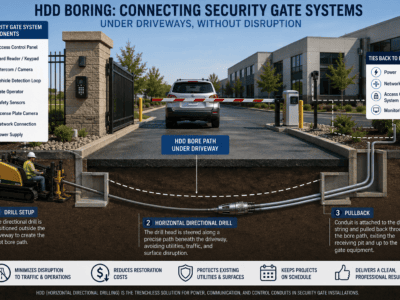
Modern commercial gate systems aren’t just a motor and a keypad anymore. Typical installs now include:
- Access control panels and card readers
- License plate recognition (LPR) cameras
- Intercom and video systems
- Vehicle detection loops and safety sensors
- Network connectivity (fiber or CAT6)
- Power redundancy systems
For electricians, that means more conduits, more coordination, and more underground routing challenges—especially in developed areas where trenching isn’t practical.
What Is HDD Boring—and Why It Matters Here
HDD (horizontal directional drill) boring is a trenchless method used to install conduit underground without disturbing the surface. Instead of cutting trenches through asphalt, concrete, or landscaped areas, crews drill a guided path beneath obstacles and pull conduit back through. This conduit then creates a pipe to install a variety of cables.
In the Denver metro area, this is especially valuable because of:
- Existing infrastructure congestion
- Strict municipal restoration requirements
- High-traffic commercial properties
- Freeze-thaw cycles that punish poorly restored trenches

Where HDD Fits in a Security Gate Project
1. Crossing Drive Lanes and Entry Points
Security gates are typically installed at the most sensitive and high-traffic areas of a property—entry drives.
Open trenching across these lanes:
- Disrupts business operations
- Requires traffic control and extended closures
- Adds significant restoration costs
HDD allows electricians to run power and data under the drive without shutting it down.
2. Connecting Gate Equipment to Buildings
Gate systems often need to tie back to a main building for:
- Power supply
- Network connectivity (which often means fiber optic cables)
- Monitoring systems
When that building is separated by parking lots, sidewalks, or landscaping, HDD becomes the cleanest solution.
Instead of cutting across finished surfaces, conduit is installed underground with minimal visible impact.
3. Navigating Existing Utilities
In older parts of Denver and surrounding suburbs, underground utility congestion is a real issue.
HDD allows for:
- Precise routing around existing utilities
- Reduced risk compared to open trench excavation
- Better control in tight corridors
For electricians, this means fewer surprises and safer installs. Your HDD crew will work with the Colorado 811 system or a private locator to identify any existing underground facilities.
4. Preserving Finished Surfaces
Many commercial clients—especially in education, healthcare, multifamily, and Class A office spaces—have strict requirements around site appearance.
HDD avoids:
- Saw-cutting decorative concrete
- Damaging new asphalt
- Tearing up landscaped areas
This is a major selling point when working with property managers and developers. And makes area restoration MUCH easier.
Why Electricians Should Plan for HDD Early
One of the most common issues in security gate projects is bringing in HDD too late.
When directional boring isn’t considered during design or bid phases:
- Conduit routes may be impractical
- Budgets get blown by change orders
- Schedules slip due to redesign
Smart electricians in the Denver metro are now:
- Coordinating with HDD contractors during pre-construction
- Including trenchless options in bids
- Designing conduit paths with boring in mind
Local Considerations in the Denver Metro Area
HDD isn’t just a convenience here—it’s often the best option due to local conditions:
- Soil variability: From clay-heavy zones in Aurora to rocky pockets in Commerce City
- Municipal requirements: Strict restoration standards in cities like Thornton and Northglenn
- Weather impacts: Freeze-thaw cycles that can compromise trench repairs
- Urban density: Limited room for open excavation in developed corridors
Working with a contractor experienced in these local conditions reduces risk significantly.
Collaboration: Electricians + HDD Contractors
The most successful security gate installs happen when electricians and HDD crews work as a coordinated team.
Key collaboration points include:
- Entry and exit pit placement
- Conduit sizing and pull requirements
- Depth planning for future protection
- Coordination with other trades (especially concrete and paving)
When this coordination happens early, projects move faster and look better when finished.
When HDD May Not Be Necessary
HDD isn’t always required. In some cases, traditional trenching still makes sense:
- Open, undeveloped areas
- Short, unobstructed runs
- Sites with planned full-scope excavation
But in most retrofit or high-traffic commercial gate projects, HDD is the more efficient and cost-effective approach.
Final Thoughts: Building Smarter Gate Infrastructure
For electricians and commercial security companies in the Denver metro area, HDD boring isn’t just a specialty service—it’s a strategic tool.
As gate systems become more advanced and site constraints tighten, integrating HDD into your project planning helps:
- Reduce disruption
- Improve installation quality
- Protect client property
- Keep projects on schedule
Call to Action
If you’re planning a commercial security gate project in the Denver metro area and need a reliable partner for directional boring, Communication Construction & Engineering can help you streamline the underground portion of your install.
Leave a Reply